

How transparency, proper resourcing and shared responsibility can narrow the audit expectation gap. Insights from the Auditors’ Roundtable and the Audit Trust & Confidence Survey.
On 12 November 2026, the Auditors’ Roundtable brought together senior representatives of UAE regulatory authorities, audit practitioners, legal professionals, representatives of ICAEW and ACCA, and educators. Building on last year’s discussion, the conference examined how audit quality can be strengthened and public confidence maintained as markets grow, reporting becomes more complex and technology reshapes the audit. Roundtable discussions on AI and the expectation gap were complemented by a live Audit Trust & Confidence Survey.
Executive Summary
Trust in audit is solid but qualified. Participants rated public trust as moderate to high, placed integrity and independence far above technical skill as its foundation, and pointed to corporate failures and inconsistent quality as the forces that erode it. They saw the clearest opportunity was in communication, only 30% felt audit reports communicate key risks effectively, while 90% believed disclosing audit quality indicators would build trust. Behind quality, they saw a capacity challenge of budgets, fees and experienced people; ahead, a technology opportunity that must be governed with care. This paper sets out those themes, the role each stakeholder can play, and six takeaways for the profession.
51% rate public trust in audit high or very high (46% moderate) | 60% say auditors protect stakeholder interests to a great extent (32% to some extent) | 69% are confident auditors apply enough professional scepticism (28% neutral) |
IN THIS PAPER 01 Why this conversation matters now 02 Trust is a shared system, not a single opinion 03 Ethics before expertise 04 The expectation gap: narrowing or widening? 05 Communication is the weakest link 06 A role for every stakeholder 07 Quality depends on resources 08 AI: a stronger performer, not a substitute for judgement 09 Regulation, enforcement and tone 10 From confidence to trust | PERSPECTIVES REPRESENTED ■ UAE regulators ■ Financial services regulators ■ Audit firms ■ The legal professionals ■ ICAEW ■ ACCA
|
01 Why this conversation matters now
Audit sits at the centre of confidence in financial reporting, and in the UAE the stakes are rising. One financial services regulator described tremendous growth in retail clients and companies within its jurisdiction; another noted that the number of Authorised Firms is growing, with supervision teams working hard to ensure the right quality standards are set. More entities, more investors and more public interest mean greater reliance on the auditor’s opinion.
At the same time, the context for audit is shifting. Reporting requirements are expanding, business is becoming more complex, and AI and data analytics are changing both how audits are performed and what stakeholders expect of them. The regulatory authorities opened the conference by stressing the importance of delivering audit quality and maintaining public trust, and of continuing to do so, a reminder that trust is not won once, but sustained.
The roundtable was designed to test these pressures from several angles, perspectives from UAE regulatory authorities, a live survey of participants, and two facilitated table discussions, one on audit quality in an era of AI and technology, the other on the evolving expectation gap, with particular focus on going concern and fraud. Each table presented its views back to the room, so practitioners, regulators, lawyers, educators and professional bodies could hear and challenge one another’s perspectives.
02 Trust is a shared system, not a single opinion
The regulatory perspectives shared a common thread, regulators, auditors and finance professionals must act together to preserve public trust, and more regulators should be brought under the same umbrella. One financial services regulator identified finance officers, management and auditors as the key participants in the ecosystem, each with a role to play. Another emphasised that audit quality and public trust are key as its market grows, noting that setting the right tone is often challenging.
A financial services regulator described audit quality as a loop in which every link must hold for quality to be sustained: accepting the right engagements, safeguarding integrity and independence, committing the right resources, investing in people and, as the outcome, delivering a quality audit. A weakness at any point, whether in client acceptance, resourcing or culture, travels around the loop and ultimately surfaces as a shortfall in audit quality.
The audit quality loop, as described by a financial services regulator
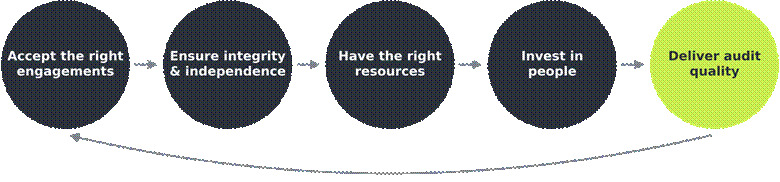
Each element fulfilling its obligations keeps the ecosystem intact.
Survey responses reflected broadly positive views, although not unqualified. Only 3% rated public trust in the profession as low and none as very low, but just 13% rated it very high, ‘moderate’ was the most common answer (46%). The pattern repeats elsewhere: 60% said auditors protect the interests of investors, regulators and other stakeholders to a great extent and none said ‘not at all’, while 69% were confident that auditors exercise sufficient professional scepticism but only 8% were very confident. The picture is one of solid but qualified confidence, with clear room to move from ‘moderate’ to ‘high’.
03 Ethics before expertise
If trust is a shared system, what holds it together? Asked which single factor most influences public trust in auditors, participants gave an unambiguous answer: integrity and ethical conduct, and independence and objectivity, were joint first, each chosen by 41%. Technical competence and transparency of communication drew 8% each, and industry knowledge just 2%.
Competence is expected, character is what earns trust. Stakeholders judge auditors first on whether they are honest and free from influence, so an ethical lapse damages confidence quickly, it strikes at the very attributes on which trust rests.
Yet when asked about the biggest challenge to trust today, participants pointed to outcomes rather than principles. Corporate scandals and failures (47%) and inconsistent audit quality across firms (33%) accounted for four in five responses. Independence concerns (8%), lack of transparency (6%) and rapid technological change (6%) trailed well behind.
Two readings follow. Independence is valued most but cited least as a current threat, suggesting it is seen as broadly well safeguarded, an asset to protect rather than a problem to fix.
Trust is a collective good: when quality varies between firms, or a failure makes headlines, the whole profession bears the cost.

04 The expectation gap: narrowing or widening?
Participants agreed that the expectation gap is real and that the public holds auditors to a high standard, but they differed on its direction. Some felt it has narrowed over the past three decades as public understanding of audit has grown. Others argued it has widened, rising regulatory demands and expanded reporting requirements have heightened the risks auditors must address, while advancing technology has led many to assume that auditors have complete knowledge and can test large populations, up to 100% coverage, rather than relying on samples.
The round table discussion examined where expectations and responsibilities diverge most, the purpose and scope of an audit, reasonable assurance, materiality, management’s own responsibilities and the inherent limits of an external audit. These concepts are well understood within the profession but less so outside it, and this difference in understanding remains a key contributor to the expectation gap.
Where views differed: Narrowing - public understanding has increased over three decades. Widening – responsibilities, complexity, expanded reporting and technology fuel an expectation of 100% testing.
■ Going concern
Going concern was a focal point. The discussion considered the respective responsibilities of management, those charged with governance and the auditor, including the assessment period, material uncertainty, audit reporting and communication with stakeholders. The view was that audit principals need to engage directly with the board, reinforced by non-executive directors where they sit on it, so that each party’s responsibilities are clearly understood.
■ Fraud
On fraud, the challenge is the distance between a public expectation that auditors will find fraud and the auditor’s responsibility to obtain reasonable assurance. The discussion considered professional scepticism, management override, the risk of sophisticated collusion, communication of identified matters and the role of other stakeholders in preventing and detecting fraud. Ongoing ISA 260 communication with those charged with governance, with feedback obtained, was seen as constant reinforcement that keeps expectations aligned.
The survey adds nuance. 69% are confident auditors, exercise sufficient professional scepticism, but only 8% are very confident and 28% are neutral. And 13% chose increased focus on fraud detection as the single change that would most improve trust, a minority view, but a reminder that fraud remains the issue on which public and professional expectations are furthest apart.
05 Communication is the weakest link
Communication emerges as the clear area for improvement. Only 30% felt audit reports communicate key risks and findings to stakeholders effectively, 62% said moderately, 8% ineffectively or very ineffectively, and none very effectively. If informed practitioners and regulators rate reports only moderately effective, the challenge may be greater still for a public at large.
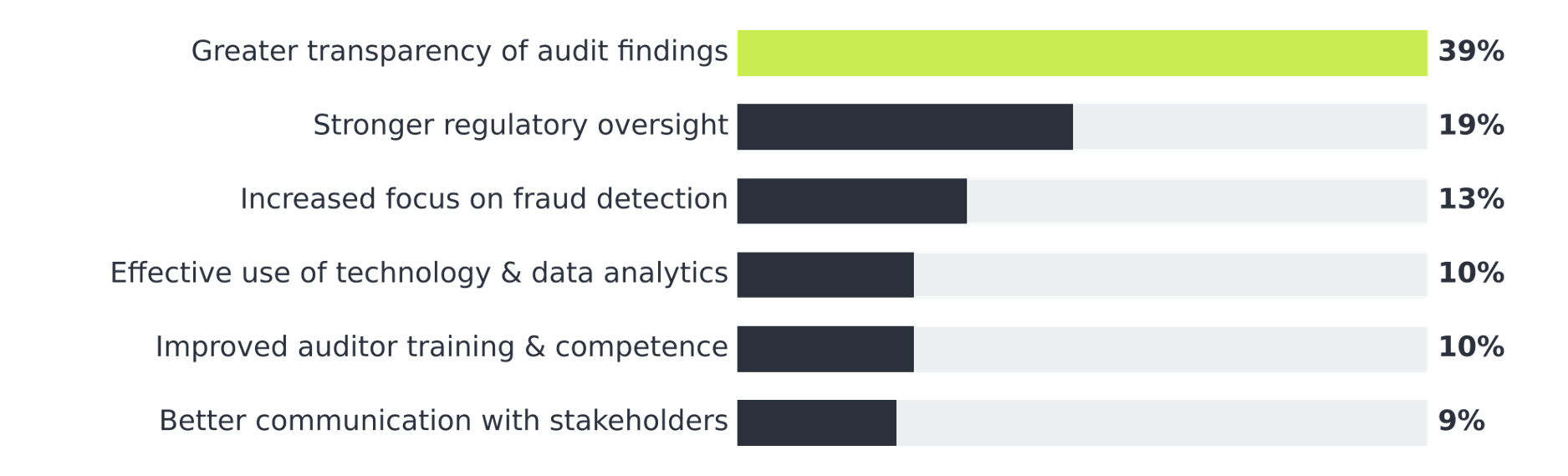
Asked what most would improve trust, participants favoured openness over process. Greater transparency of audit findings led (39%), ahead of stronger regulatory oversight (19%), increased focus on fraud detection (13%), effective use of technology and data analytics (10%), improved training and competence (10%) and better communication with stakeholders (9%). Transparency alone outscored technology and training combined.
What would most improve trust in the audit profession?
The appetite for openness extends to firms. 90% said disclosing audit quality indicators, such as inspection results, partner workload and staff experience, would increase trust in audit firms, the strongest consensus in the survey. Most said ‘somewhat’ (68%) rather than ‘significantly’ (23%), only 2% saw no difference and 7% were unsure. Disclosure is seen as a meaningful step, not a cure-all.
The roundtable considered what clearer communication looks like in practice, clearer audit reports, transparent communication with audit committees and stakeholders, education on audit responsibilities, timely escalation of concerns, and better explanation of significant judgements and the limitations of an audit. None of these requires a change in the auditor’s responsibilities, all of them change how those responsibilities are understood.

06 A role for every stakeholder
The roundtable was clear that no single party can close the expectation gap. The practical actions identified extend across the whole reporting ecosystem. The regulator presented infinity loop that included various stakeholders responsibility to improve audit quality.
Auditors Communicate clearly what an audit does and does not provide, particularly on fraud and going concern. | TCWG & CFO Strengthen transparency and explain management’s responsibilities for reporting, controls and risk management. | Regulators Continue to monitor and provide clear, practical guidance on what good audit quality looks like and communicate inspection themes consistently. | Standard setters Keep standards understandable and relevant and help audit reports explain complex matters more clearly. |
Professional bodies & educators Lead the change by building and spreading a deeper understanding of audit, while embedding AI skills into training and the curriculum and educating members, students, and the public on how AI is reshaping audit and the profession. | Independent investors & private equity Invest in quality and long-term sustainability rather than short-term returns, supporting strong governance and properly resourced audits in the businesses they back, while maintaining appropriate safeguards to avoid conflict of interest. | Analysts & credit rating agencies Draw on audit outcomes in their assessments and help translate assurance into market understanding, while interpreting audit reports constructively and providing balanced, positive commentary. | Clients and bank Clients should give auditors timely, complete information and open access, while banks should engage constructively with audit reports and assurance they provide, helping strengthen understanding and market confidence. |
Areas for improvement, whether identified through inspections, surveys or stakeholder feedback, should be treated constructively as opportunities to strengthen the profession.
07 Quality depends on resources
Asked for the biggest challenge in maintaining audit quality, participants pointed to capacity rather than capability. Budget and resource constraints on engagements (41%) and the loss of experienced professionals to industry (25%) together made up two-thirds of responses. Increasing complexity of business and reporting requirements (22%) and regulatory deadlines and time pressure (12%) followed.
Audit quality depends not only on technical standards, but also on sufficient time, experienced people and fees that support the work required.. Technical competence ranked low as a driver of trust, yet losing experienced people ranks high as a threat to quality, experience is taken for granted until it leaves.
Written suggestions reinforced the point. Fees were the most frequent theme in the one change participants would make, charging the right fee to resource engagements, keeping management out of fee setting, transparency of fees and minimum regulatory fee levels. Transparency, independence and regulatory oversight followed. This echoes the regulator’s loop described earlier, in which the right resources and investment in people come before quality.

Themes in written suggestions for the one change that would most strengthen trust
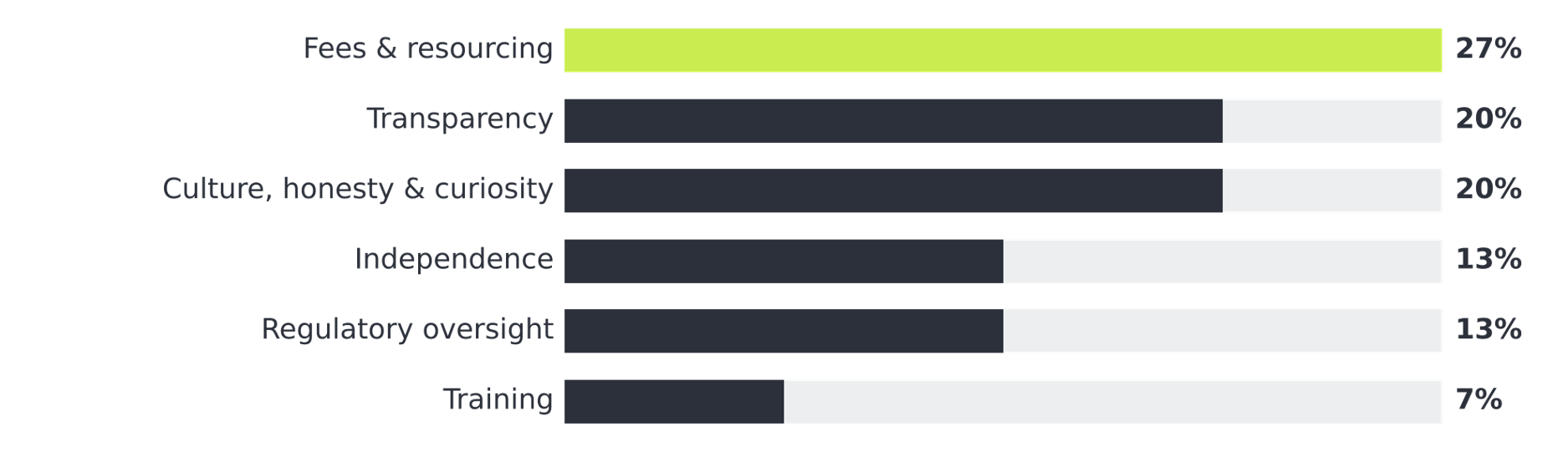
Share of written suggestions; themes grouped by the authors.
Read together, the written responses fall into two clusters. One concerns the economics of audit: fees and resourcing were the single most frequent theme. The other concerns behaviour: independence, culture, honesty and curiosity together accounted for a third of suggestions. Coaching and training within firms were also emphasised in the AI discussion. Quality, in other words, needs both the means and the mindset.
08 AI: a stronger performer, not a substitute for judgement
Optimism about technology is real but cautious. 87% said greater use of technology and AI would increase their confidence in audit outcomes, yet only 11% said significantly; 5% saw no impact and 8% expected confidence to fall somewhat. Just 10% chose technology as the change that would most improve trust, suggesting it is seen as an enabler of quality rather than a source of trust in itself.
The discussion struck the same balance, AI should make audit better, not bigger, acting as a performer rather than a reviewer, with humans leading the process. Some noted it eases testing of large populations, others stressed the risks and the need for controlled use, training and firm-approved tools. Educators are adding AI modules to the Chartered Accountancy curriculum.
Regulators added a note of caution, they were of the view that they are yet to see any improvement in audit quality as a result of investment in AI by practising firms. The challenge for the profession is to turn that investment into quality outcomes that can be demonstrated.
The table discussion was framed around four questions: how AI, data analytics and automation can enhance quality, for example in risk assessment, analysis of larger data populations, identification of unusual transactions, consistency of procedures and focus on higher-risk areas; how the auditor’s role and skills will change, and what must remain fundamentally human; how auditors can understand, challenge and validate technology-generated information while benefiting from greater insight and efficiency; and which principles should guide responsible use.

Principles for responsible use of AI considered by the roundtable
| Human oversight | Accountability | Reliability |
| Data quality | Confidentiality | Transparency |
| Documentation | Training | Governance |
09 Regulation, enforcement and tone
Regulators were candid that enforcement is part of their toolkit. One financial services regulator noted that recurring serious findings and elements of fraud are significant concerns which can leave it with no option other than to impose enforcement fines, and that regulators need to use all the options available to them.
Participants’ views on oversight were measured. Stronger regulatory oversight was the second most popular route to greater trust (19%), and two written suggestions called for more of it. Yet greater transparency of audit findings was chosen twice as often. The survey also points to where the profession would welcome regulators’ help: 90% support public disclosure of audit quality indicators, and the roundtable asked regulators for clear, practical guidance on what good audit quality looks like and for consistent communication of inspection themes.
Enforcement remains an important regulatory tool, particularly where serious or repeated deficiencies arise. It is most effective alongside clear expectations, practical guidance, open dialogue and timely remediation. Firms, in turn, should respond constructively to inspection findings and demonstrate that improvements have been made.
What the roundtable asked of regulators
|
10 From confidence to trust
The roundtable showed a profession confident in its foundations and candid about its gaps. Trust in audit is rated moderate to high, anchored in integrity and independence, and threatened most by failures and inconsistency. The opportunities are equally clear: explain the audit better, make quality visible, resource it properly and adopt technology responsibly.
Six key takeaways
- Trust is earned on ethics first. 82% named integrity or independence as the biggest driver of trust; quality initiatives should be visibly anchored in both.
- Explain the audit, not just the opinion. Say clearly what an audit does and does not provide, especially on fraud and going concern, in reports and ongoing dialogue with boards.
- Make audit quality visible. 90% believe disclosing audit quality indicators would build trust, supported by consistent communication of inspection themes.
- Resource quality properly. Budget pressure and talent loss are the leading perceived threats; fees and resourcing are quality issues, not only commercial ones.
- Let technology strengthen judgement, not replace it. Adopt AI through governed, firm-approved tools with training and human oversight, and manage the expectations it creates.
- Use enforcement proportionately. Regulatory fines are a tool often used by regulators. While such measures are needed, excessive use of this tool can damage the trust and reputation of the profession.
Related content


