
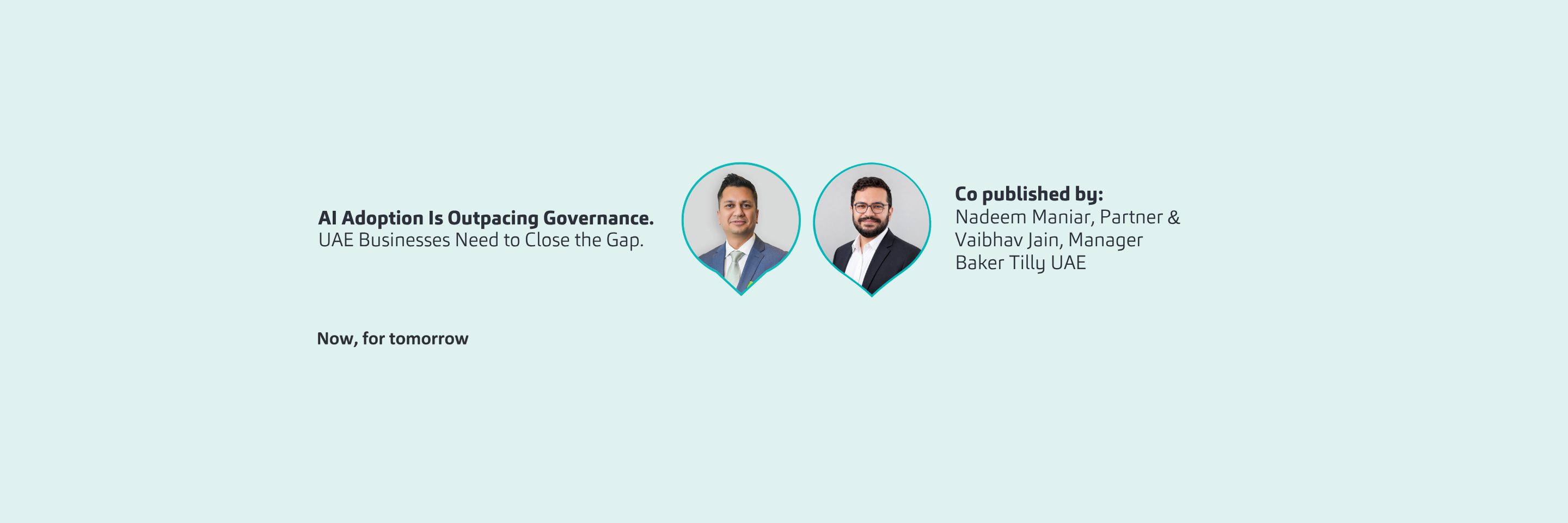
AI Adoption Is Outpacing Governance. UAE Businesses Need to Close the Gap.
Artificial Intelligence is no longer an emerging technology. Across the UAE, organisations are embedding AI into customer service, finance, operations, compliance, software development, and decision-making processes at a remarkable pace. The opportunities are significant, from improving efficiency and reducing costs to enhancing customer experience and unlocking new insights.
However, while AI adoption is accelerating, governance frameworks are often struggling to keep up.
In many organisations, AI initiatives are moving ahead faster than the controls needed to manage them. This creates a growing risk gap, one that boards, executives, and risk leaders can no longer afford to overlook. AI introduces challenges that go well beyond traditional technology risks and raises important questions around accountability, transparency, cybersecurity, data privacy, regulatory compliance, and operational resilience.
Why AI Requires a Different Governance Approach?
Traditional governance and control frameworks were built for technology environments that are largely predictable and rule-based. AI systems operate differently.
They learn from data, evolve over time, and can influence or automate critical business decisions. This creates risks that many existing control environments were never designed to address, including inaccurate outputs, model bias, manipulation of AI models, unauthorised access to training data, and excessive reliance on automated decisions.
The growing use of generative AI tools also increases the likelihood of confidential information being shared with external platforms. In regulated sectors, this can quickly become a compliance, legal, and reputational concern. As regulatory expectations continue to evolve, organisations will increasingly be expected to demonstrate that AI is being deployed responsibly and under appropriate oversight.
Existing Control Frameworks Are No Longer Enough
Most organisations already have established cybersecurity, information security, and risk management programmes. These remain essential foundations, but they were not designed with AI in mind.
Governance frameworks now need to expand beyond traditional controls and address areas such as:
- AI model governance and security
- Data quality and training data management
- Monitoring and validation of AI outputs
- Third-party AI provider oversight
- Transparency and explainability of AI-driven decisions
- Human review and accountability mechanisms
Without these enhancements, organisations risk introducing governance blind spots that could lead to operational failures, regulatory scrutiny, cybersecurity incidents, and loss of stakeholder confidence.
What Should Organisations Do Now?
The most effective organisations are not treating AI as a standalone technology project. They are embedding AI governance into their broader risk and governance structures.
The starting point is clear accountability. Boards, audit committees, executive management, and risk functions should have visibility over how AI is being adopted and how associated risks are being managed. AI risks should be incorporated into enterprise risk management frameworks, with defined ownership, monitoring, and reporting mechanisms.
Organisations should also assess whether their existing cyber risk assessments adequately cover AI environments. Traditional approaches often overlook AI-specific threats such as model compromise, data poisoning, adversarial attacks, and unauthorised access to AI models.
Cybersecurity Must Evolve Alongside AI
As AI becomes embedded in critical business processes, protecting traditional IT infrastructure is no longer sufficient.
Organisations need to apply the same discipline and rigour to securing AI models, training datasets, APIs, and automated decision-making systems. Strong data governance, continuous monitoring, third-party risk management, and AI-focused incident response planning are becoming essential components of cyber resilience.
Those that invest early in these areas will be better positioned to manage emerging threats while maintaining business continuity and stakeholder trust.
The Growing Importance of Independent Assurance
AI governance should not rely solely on management oversight.
Internal audit and assurance functions have an increasingly important role in providing independent assessment of AI-related risks and controls. Boards and audit committees are seeking greater confidence that AI systems are operating effectively, delivering intended outcomes, and remaining within acceptable risk tolerances.
Forward-looking organisations are already expanding their assurance programmes to include AI governance, AI risk management, data governance, model validation, and regulatory compliance reviews. These reviews help identify control gaps before they become significant business issues.
Looking Ahead
The future of AI in the UAE is undoubtedly exciting. Organisations are investing heavily in AI to drive innovation, enhance efficiency, and create competitive advantage.
However, long-term success will depend not only on how quickly organisations adopt AI, but on how effectively they govern it.
The businesses that will derive the greatest value from AI are unlikely to be those that move first. They will be the organisations that combine innovation with strong governance, robust risk management, and effective oversight. By doing so, they can capture AI's benefits with confidence while protecting their organisation, stakeholders, and reputation.
How Baker Tilly UAE Can Help
As one of the top audit firms in the UAE and part of the world’s 8th (eighth) largest audit and consulting network, Baker Tilly UAE partners with Boards, Audit Committees, CEOs, and CFOs to enhance corporate governance, AI governance, Information Security, Cyber Security, IT governance, IT controls, and internal controls across their organisations. Our specialised advisory and assurance services include IT Audit, Cyber Security Audit, Information Security Audit, IT Controls Review, Special Purpose Audit, Internal Audit and Governance Advisory Services, helping organisations strengthen cyber resilience, manage emerging technology risks, achieve regulatory compliance, and build stakeholder confidence. We support businesses across the UAE in navigating complex governance, risk, and compliance challenges while driving operational excellence, resilience, and sustainable long-term growth.
Related content


